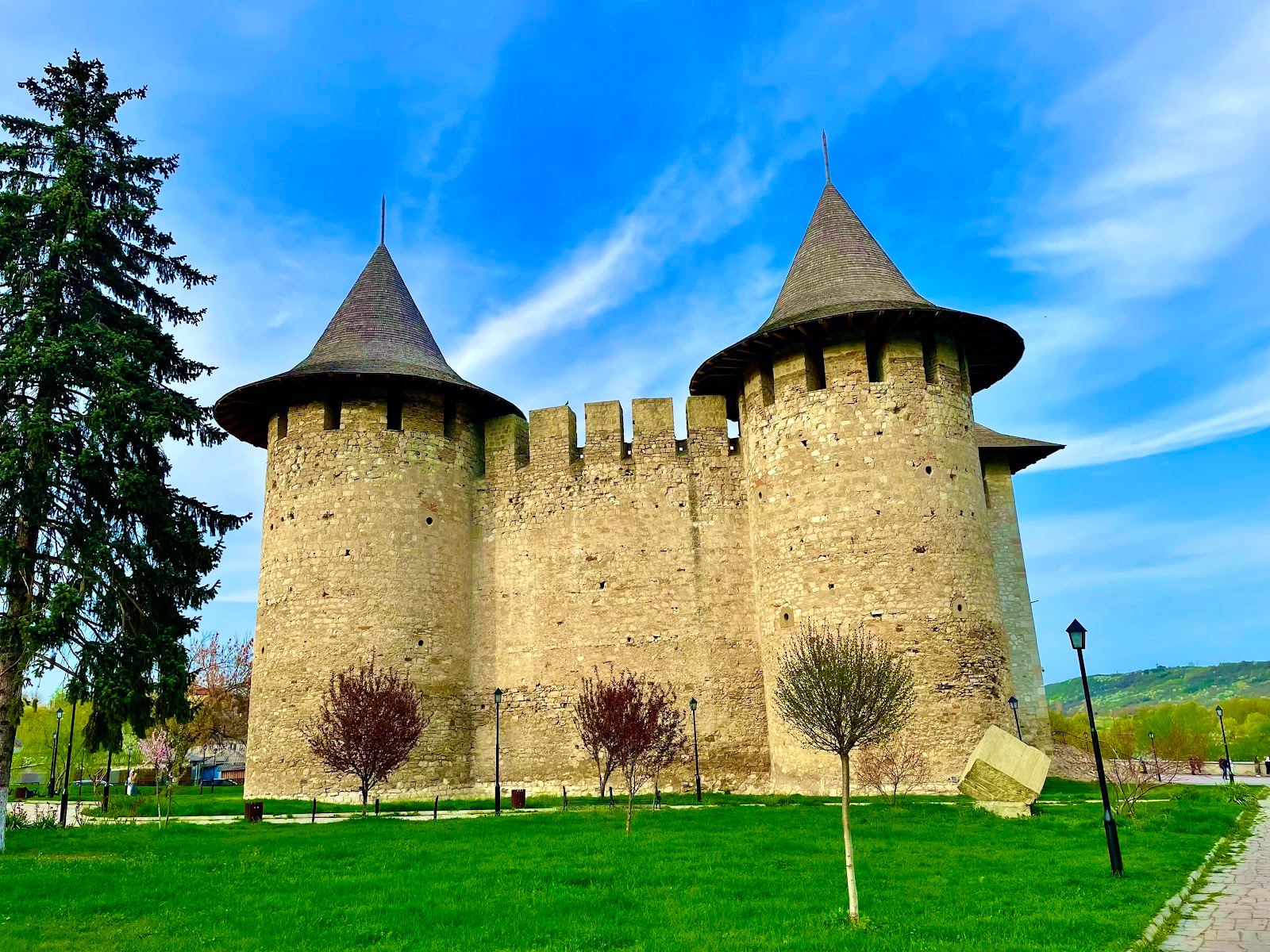
Moldova doesn't have dozens of castles, like some countries. What it has instead are two stone fortresses that guarded the Dniester fords for centuries - Soroca and Tighina - and a handful of boyar manors raised later, when quiet replaced sieges. Together they tell the story of those who ruled and defended these lands: princes and sultans at the walls, then diplomats and boyars in salons with parks.
The two fortresses are part of a chain of forts along the Dniester - Hotin, Soroca, Tighina, Cetatea Albă - whose ends are now in Ukraine, while the two middle ones remain in Moldova. Soroca is a perfect stone circle, perhaps the best-preserved medieval fortress in the country. Tighina, rebuilt by the Ottomans, is where the King of Sweden found refuge after a famous defeat.
On the map
The Dniester · the two stone fortresses
A perfect circle in the north and an Ottoman stronghold in the east - the forts that guarded the river's fords.
Start with Soroca, in the north. Stephen the Great raised a wooden fort here on the Dniester bank in 1499, and his son Petru Rareș rebuilt it in stone between 1543 and 1546 - the form you still see today. It's an almost perfect circle, with five towers, thick walls and a wall-walk from which you look out over the river and the Ukrainian bank beyond. Precisely because it was built compact and never brutally modernized later, it's one of the most complete medieval fortresses in the region.
Petru Rareș's round fortress on the Dniester bank. You climb the wall-walk, step into the towers and the inner chapel, and from the top you see the town and the river.
Getting there By car, about 2.5-3 hours from Chișinău (~160 km), heading north. It's a full day; combine it with the "Candle of Gratitude" monument on the hill above the town.
Tip The fortress museum is usually closed on Monday and Tuesday - plan your visit later in the week and confirm the hours before you set off.
A stone circle raised in 1546, so complete it looks lifted from a film.
At the other end of the road is Tighina, in Bender, much closer to Chișinău. There was first a Moldavian fortification here, but in 1538 Sultan Suleiman the Magnificent took it and rebuilt it in stone, to a design attributed to the great Ottoman architect Mimar Sinan - the same man behind the Süleymaniye Mosque in Istanbul. For centuries it was an Ottoman military base on the Dniester, besieged in vain by Moldavian princes. Its most famous episode: King Charles XII of Sweden took refuge here after his defeat at Poltava, and in 1713 his small guard fought Ottoman troops in what became known as the "Skirmish at Bender".
The Ottoman stronghold at Bender, rebuilt in stone after 1538. Today it's a museum complex with bastions, the Alexander Nevsky Church and an amusing monument to Baron Münchhausen.
Getting there About 1-1.25 hours from Chișinău (~65 km). Bender is in the Transnistria region: at the checkpoint you need your passport and receive a migration card (keep it until you leave), and Western cards don't work - bring cash. See the practical section below.
Tip The legend of Baron Münchhausen riding a cannonball is set right at the siege of Bender - the town plays with the story, and there's a bust dedicated to it.
The Centre · the manors near Chișinău
An Armenian diplomat's palace on a hill and a boyar manor where Pushkin once stayed - both under an hour from the city.
At Hîncești, on a hill above the town, stands Moldova's best-restored manor. It bears the name of Manuc Bey, an Armenian-born merchant and diplomat, a novelistic figure of the early 19th century (the same man who built the famous Manuc's Inn in Bucharest). He bought the estate in 1817 but died that same year; the palace was raised by his descendants, around 1857-1861. It isn't a single house but a complex: the princely palace, a neo-Gothic "hunting castle" - the castle image you remember - the steward's house, the watchtower.
The restored princely palace and the neo-Gothic hunting castle, on the hill above Hîncești. Today they house museum rooms and exhibitions of local archaeology and ethnography.
Getting there By car, about 45 minutes from Chișinău (~35 km to the south-west). Easy to combine with a winery in the Codru area.
Tip The small neo-Gothic hunting castle is the most photogenic. Guided tours start from about 30 lei; it's open daily except Monday - confirm the hours first.
About an hour from Hîncești, in the Codru forest, is the manor of the Ralli boyars at Dolna. It's a modest house with one big story: in the summer of 1821 the young Alexander Pushkin, exiled to Chișinău, was brought here by his friend Iancu Ralli. In the nearby forest he came upon a Roma camp, and the encounter inspired his poem "The Gypsies". The place keeps to this story - it has a "Zamfira's Spring" in the woods, a monument to the poet in the garden and, in the house, a room devoted to the poem.
The restored manor at Dolna, with nine themed rooms and an exhibition on "The Gypsies". Around it, the Codru forest and the path to Zamfira's Spring.
Getting there About an hour from Chișinău (~50 km to the north-west), on forest roads. Loveliest in spring and autumn.
Tip Leave time for a walk in the forest to Zamfira's Spring and the Zamfira Glade. The museum is open 10:00-16:00, closed on Mondays.
One of the best-known poems in Russian literature began in a forest village in Moldova.
Orhei and the North · manors to discover
A restored Armenian manor near Orheiul Vechi and, far in the north, Moldova's largest park around an unfinished palace.
At Ivancea, near Orhei, is the manor of Carabet Balioz, another Armenian merchant, raised in the mid-19th century from Butuceni stone - the same stone as the Orheiul Vechi cliffs. It's a classical-style building with a three-level water tower and a park of some three hectares. It was restored and reopened in 2023, and now houses a museum about the Balioz family and the stonework of the Orhei region - for a long time this held Moldova's richest folk-crafts museum.
The Balioz manor at Ivancea, restored in 2023, with its water tower and park. A branch of the Ethnography Museum, with exhibitions on the family and on stone craft.
Getting there About 45 minutes from Chișinău (~40 km to the north), near Orhei. Combine with Orheiul Vechi and its cave monastery.
Tip It's a step from Orheiul Vechi - the two pair perfectly in one day. Being freshly reopened, confirm the current hours and exhibitions before your visit.
The farthest stop is also the most unusual. At Țaul, in the north (Dondușeni district), the banker Andrei Pommer began around 1900 to raise a palace and plant a huge park. He died in 1912 without finishing the palace, and the building has been more ruin than manor ever since. The park, though, is the star: nearly 46 hectares, the largest landscape park in Moldova, with about 150 species of trees and shrubs, many of them exotic. It's the kind of place you come to for allées, shade and quiet, not for restored salons.
Țaul park - the largest in Moldova - and Pommer's unfinished palace. You come for the park and the photogenic facade, not for interiors: the building is a beautiful ruin, a work in progress.
Getting there By car, about 3 hours from Chișinău (~200 km to the north). It's a weekend destination; it combines naturally with Soroca fortress, in the same part of the country.
Tip Come for the park, with realistic expectations about the palace. It's superb in autumn. Being far, tie it to Soroca or the northern monasteries over a weekend.
Practical
How to get there
- By car · the best option. Manuc Bey (Hîncești), Ralli (Dolna) and Balioz (Ivancea) are 45 min - 1 h from Chișinău. Tighina is ~1 h to the east, but in Transnistria (see below). Soroca and Țaul are in the north, 2.5-3 h - weekend stops.
- A day vs a weekend · in a day you comfortably do the central manors (Manuc Bey + Ralli) or Balioz + Orheiul Vechi. Soroca fortress and Țaul park need a weekend, being up north.
- Organized tour · Chișinău agencies run regular trips to Tighina (often with Tiraspol) and to Soroca, with transport and a guide.
Visiting Tighina (Transnistria)
- Bender is in the Transnistria region, run as a de-facto separate administration since 1991. Chișinău considers it Moldovan territory, but in practice you cross a checkpoint.
- Passport · you need it at the checkpoint. You receive a migration card (often valid ~10 hours for a day trip) - keep it until you leave.
- Cash · Visa/Mastercard don't work there; the local currency is the Transnistrian ruble. Bring lei or euros to exchange.
- It's a common day trip from Chișinău, generally calm for tourists. Still, as an area with a special status, carry your documents and check travel advisories beforehand.
When to go
- Spring and autumn · the best light for walls and parks. Țaul park is superb in autumn, with the foliage of its exotics.
- Closing days · many museums close on Mondays (Manuc Bey, Ralli), and Soroca fortress usually on Monday and Tuesday - plan your visit for mid-to-late week.
- Summer · pleasant, but bring water and a hat for the fortresses - the wall-walks are exposed to the sun.
Unexpected questions (with short answers)
Which is the best-preserved fortress in Moldova?
Soroca Fortress. It's an almost perfect stone circle with five towers, rebuilt by Petru Rareș between 1543 and 1546 and fully restored in recent years. Precisely because it was built compact and never brutally modernized, it's one of the most complete medieval fortresses in the region. Tighina Fortress at Bender is larger and more complex, but it sits in Transnistria.
Is it complicated to visit Tighina fortress, in Transnistria?
Not very, but it's different. Bender is in the Transnistria region, run as a de-facto separate administration, so you cross a checkpoint where you need your passport and receive a migration card to keep until you leave. Western cards don't work, so bring cash. It's a common day trip from Chișinău, generally calm for tourists; still, carry your documents and check travel advisories before you go.
What's the difference between a fortress and a manor?
A fortress is a military structure - walls, towers, bastions - built to defend a ford or a town. Soroca and Tighina are fortresses. A manor is the country residence of a boyar or a wealthy man, a home with gardens and a park, built later, once the age of sieges had passed. Manuc Bey, Ralli, Balioz and Pommer are manors. The route pairs them because, from two angles, they tell the story of those who ruled these lands.
What is Pushkin's connection to Moldova?
Alexander Pushkin was exiled to Chișinău between 1820 and 1823. In the summer of 1821 he was a guest at the Ralli boyars' manor at Dolna, in the Codru forest. There, an encounter with a Roma camp inspired his poem "The Gypsies". The manor is a museum today, with a room devoted to the poem and a path to "Zamfira's Spring" in the forest.
Is the Pommer manor at Țaul worth it if the palace is a ruin?
Yes, but for the park, not the palace. The banker Andrei Pommer died in 1912 without finishing his palace, which has been more ruin than manor ever since. The surrounding park, though - nearly 46 hectares with about 150 tree species - is the largest landscape park in Moldova and the real reason to visit. The palace facade stays photogenic. Being far, in the north, it pairs well with Soroca fortress over a weekend.