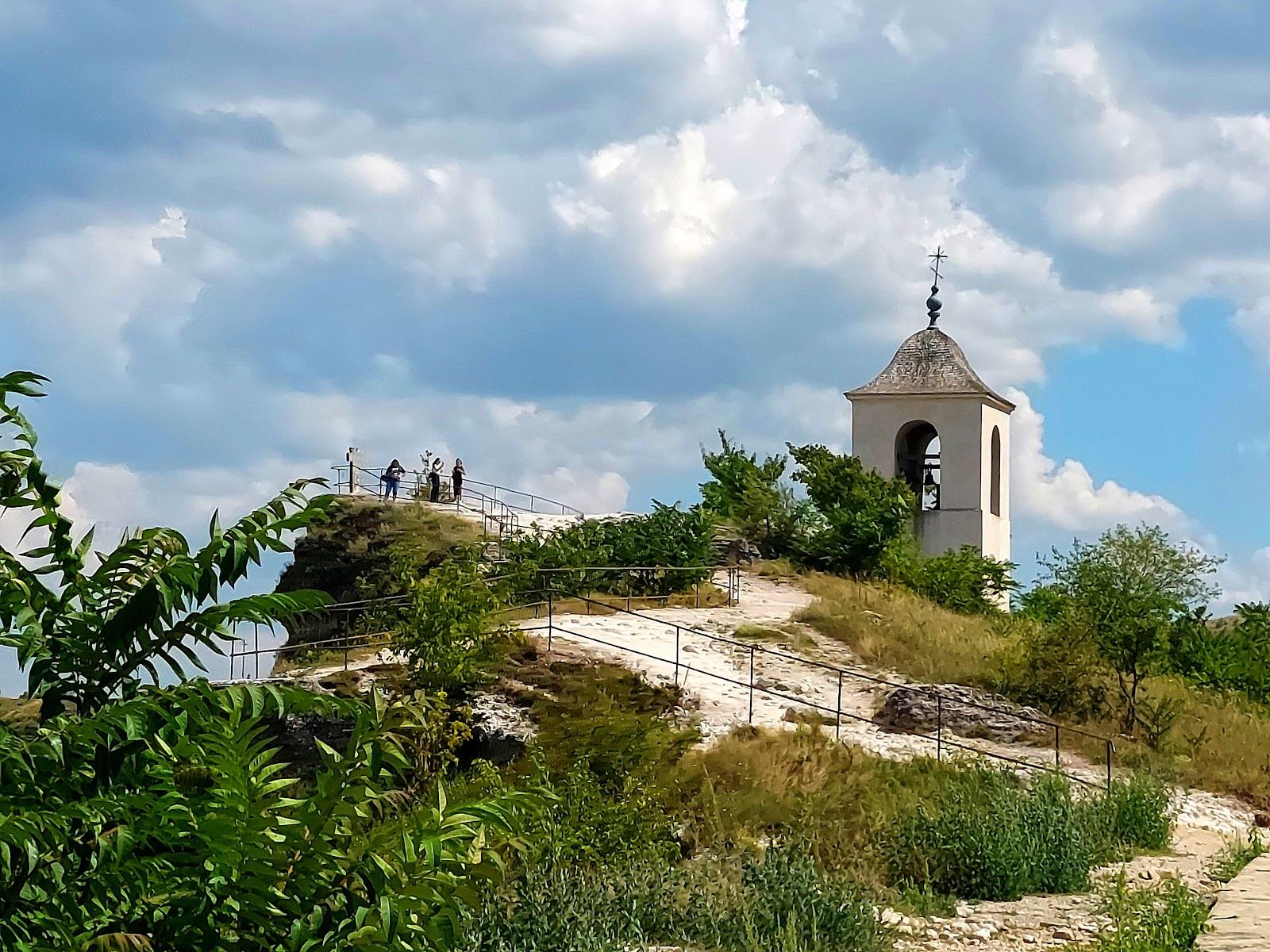
Moldova has more than a hundred active monasteries and hermitages, and the most beautiful are not in the cities but at the edge of villages, in gorges, and on the steep banks of the Dniester. Some are carved straight into the rock, with cells where monks have prayed without pause for centuries. Others are princely foundations whose stories begin with Ștefan cel Mare. And a few survived Soviet closure without stopping their prayer for a single day.
This isn't a one-way trail. Below are four regions - Orhei, the Upper Dniester, Codru, and Chișinău - each with one or two anchor monasteries told at length and a band of catalog alternatives, so you pick your own stops. In a day you do Orheiul Vechi plus one Codru monastery; over a weekend you also catch the Dniester cave monasteries; with more time, you string them all together.
On the map
Orhei · the Răut cliff and the tallest cathedral
The country's most photographed landscape and one of its most imposing monasteries, less than an hour apart.
Sixty kilometers from Chișinău, the Răut bends so tightly it has cut a limestone promontory above the villages of Butuceni and Trebujeni. There, in the 13th-14th centuries, monks carved a church straight into the rock - the Cave Monastery, with cells opening onto the cliff. It's the heart of Orheiul Vechi, Moldova's most important cultural-historical site and a UNESCO candidate. You come for the landscape and leave feeling you've seen something that exists nowhere else.
The region's anchor. The cave monastery in the Răut meander, plus Getic ruins and a landscape that lands on every cover about Moldova. Climb to the cross for the panorama.
Tip Go early morning or at sunset - the light on the cliff is spectacular and there are fewer people.
About 30 km northwest, one of Moldova's most imposing monastic ensembles, with the tallest cathedral in the country - its central dome around 57 m. The Baroque church with five domes is one of the most photogenic buildings in Moldova.
The Upper Dniester · monasteries carved in stone
Cells above the abyss, waterfalls through the forest, and prayer unbroken since 1693.
The steep bank of the Dniester hides the country's most dramatic monasteries. At Țipova, the rock-cut complex spans three levels in the cliff face above the river - one of the largest of its kind in Eastern Europe, with a legend that Ștefan cel Mare was married here. A few kilometers away, Saharna combines an active monastery with waterfalls and a Geto-Dacian fortress hidden in the forest. These are places where geology, history, and faith overlap.
One of the largest rock-cut monastic complexes in Eastern Europe, on three levels in the Dniester cliff. The descent to the cells is a small adventure - good shoes are a must.
Getting there About 100 km from Chișinău by car. From the parking you descend steep paths to the cells and the viewpoint - not stroller-accessible.
Moldova's most-visited pilgrimage site - an active monastery, a forest waterfall, and traces of a medieval fortress. Combines the spiritual, nature, and an easy hike.
At Japca, the prayer never stopped even under communism - the only monastery in Soviet Moldova never to be closed.
Codru · the foundations in the forest
The forest monasteries, half an hour from Chișinău, where history begins with Ștefan cel Mare.
Northwest of Chișinău, the Codru forests hide central Moldova's oldest monasteries. Căpriana, with its first stone church under Alexandru cel Bun (~1425) and princely-monastery status by a 1429 document, was repaired by Ștefan cel Mare and rebuilt by Petru Rareș - an ensemble the country's entire history has passed through. A few kilometers away, Hâncu is one of the best-loved convents, with a spring and a quiet atmosphere deep in the forest. All are within an hour or less of the capital - ideal for half a day.
One of Moldova's oldest and most important monasteries - a princely foundation from 1429, tied to Ștefan cel Mare. Three churches, a park, and a necropolis of metropolitans.
A 17th-century convent, one of the most popular in the country. A spring, an orchard, and a calm that explains why pilgrims love it so.
Chișinău · the city cathedrals
For those with only a few hours - Moldova's faith, without leaving town.
If you have no time for a drive, the city itself has a few worthwhile places. The Nativity Metropolitan Cathedral, in central Chișinău, with its freestanding bell tower and surrounding park, is the capital's spiritual heart. Ciuflea Monastery, with its nine domes, is a mid-19th-century city landmark. They're the perfect stops for a quiet morning before heading out to the monasteries beyond the city - or for those staying in the capital only.
Chișinău's central cathedral, in the park of the same name. The freestanding bell tower and the Triumphal Arch next to it make it the city's ceremonial heart.
An urban monastery, its cathedral built in 1854-1858, with nine domes visible from afar. The only church in Chișinău where services were held throughout the Soviet period.
Practical
How to get there
- By car · the best option. Orheiul Vechi and the Codru monasteries are 30-60 min from Chișinău; Țipova and Saharna ~1.5-2 h to the northeast; Japca and Rudi ~3 h.
- Organized tour · many Chișinău agencies run day trips to Orheiul Vechi + Curchi or Țipova + Saharna, with transport and a guide.
- Public transport · minibuses reach the larger villages, but the monasteries are often a few km from the stop - awkward without a car.
- Chișinău cathedrals · reachable on foot or a short ride within the city.
Visiting etiquette
- Dress · shoulders and knees covered. Women cover their head with a scarf; many monasteries offer skirts and headscarves at the entrance.
- Photography · church interiors usually can't be photographed (especially during service) - ask first.
- Service hours · early morning and evening. Visit quietly the rest of the day; avoid disturbing the service.
- Donations · most charge no entry; a donation for candles or the monastery is welcome.
When to go
- Spring and autumn · the best light and mild temperatures for the Țipova and Saharna hikes.
- Major feasts (Easter, each monastery's patron day) · special atmosphere, but crowds and harder access.
- Winter · the monasteries stay open, but the rock paths can be slippery - check the weather.
Unexpected questions (with short answers)
Which is the most spectacular monastery in Moldova?
It depends what you're after. For landscape, Orheiul Vechi (the cave monastery in the Răut meander) is the most photographed. For drama, Țipova - the three-level rock complex above the Dniester, one of the largest in Eastern Europe. For grandeur, Curchi, with the tallest cathedral in Moldova. For pilgrimage atmosphere, Saharna, the country's most-visited place of worship.
Can I visit the monasteries without being religious?
Yes, absolutely. The monasteries are open to visitors of any faith and most charge no entry. Respect the simple dress and quiet rules, especially during services, and ask before photographing church interiors. Many people come for history, architecture, and landscape, not only for pilgrimage.
How many monasteries can I see in a day?
Comfortably, two or three if they're in the same region. A classic day: Orheiul Vechi in the morning + Curchi in the afternoon. Or Țipova + Saharna, which are close together. The Codru monasteries (Căpriana, Hâncu, Hîrjauca) link up well. Don't try to combine the north (Japca, Rudi) with the south in one day - the distances are large.
Is there a monastery that was never closed in the Soviet period?
Yes - Japca Monastery, on the Dniester bank, is the only monastery in Soviet Moldova never closed during the Soviet period. Prayer has continued unbroken since its founding, with rock-cut origins on the Dniester cliff. It's a place with a rare story of continuity.
What should I wear when visiting a monastery?
Shoulders and knees covered, for both men and women. Women cover their head with a scarf inside the church. Many monasteries keep loaner skirts and headscarves at the entrance, but it's simpler to come prepared. For Țipova and Saharna you'll also want good hiking shoes - the paths are steep.